Unifi Switch 48 Device Busy Try Again
Unifi — troubleshooting offline deject key and other stability problems
Содержание:
- Содержание
- Введение
- Как обновить Cloud Key с помощью контроллера UniFi
- Как обновить Cloud Key с помощью интерфейса управления ключом облака
- How Device Adoption Works
- WebUI: How to Prefer UniFi Devices
- Cloud Key Gen ane Emergency Recovery
- Mobile App: How to Adopt UniFi Devices
- Step five: Install the UniFi Controller
- Step iv: Connect Via SSH to the Instance
-
- Using Windows (PuTTY)
- Using macOS or Linux
-
- Impact of key version state on cryptographic operations
- Symmetric encryption
- Asymmetric encryption or digital signing
- How to Update the Cloud Cardinal'south Firmware with the Cloud Key Direction UI
- Managing Deject Subscriptions
- View and Download UniFi Cloud Invoices
- Change Billing Data
- Alter Device Tiers
- Cancel Subscription/Trial for Unmarried Controller
- Cancel Subscription/Trial for Entire Business relationship
- Applying API cardinal restrictions
- Adding application restrictions
- Calculation HTTP restrictions
- Adding API restrictions
- Adding application restrictions
- Ubiquiti SSO Deject Credentials
-
- How to create an business relationship:
-
- Troubleshooting Indistinguishable Controllers
-
- Asunder Devices After Migration
- UniFi Mobile App Warning: Controllers with Aforementioned UUIDs
-
- Requirements
- Symptoms
Содержание
- Введение
- Как обновить Cloud Key с помощью контроллера UniFi
- Как обновить Cloud Key с помощью интерфейса управления ключом облака
Введение
Перед началом работы всегда проверяйте наличие резервной копии сетевого контроллера UniFi. Вы можете загрузить резервную копию с сетевого контроллера UniFi в Settings > Maintenance > Backup и нажмите Download Fill-in. Помните, что для восстановления резервной копии версия программного обеспечения контроллера должна быть такой же или более новой, чем версия в резервной копии
Также важно отметить, что при обновлении Ubiquiti Unifi Cloud Central, он автоматически обновит версию контроллера UniFi до соответствующей версии контроллера в комплекте
Как обновить Cloud Cardinal с помощью контроллера UniFi
i. Чтобы обновить прошивку Deject Cardinal : В контроллере сети UniFi перейдите в Settings > Maintenance > Cloud Primal Firmware и нажмите Bank check for Update. Вы увидите кнопку «Применить обновление», если доступно обновление.
2. Чтобы обновить программное обеспечение UniFi Network Controller, размещенное на облачном ключе: В UniFi Network Controller перейдите в Settings > Maintenance > Cloud Key Controller и нажмите Check for Update. Вы увидите кнопку Utilize Update, если обновление доступно.
Как обновить Cloud Key с помощью интерфейса управления ключом облака
1. Откройте веб-интерфейс управления облачным ключом, введя IP-адрес своего облачного ключа в браузере.
Напоминание
Имена переменных чувствительны к регистру.
Advanced
3. Нажмите Manage Cloud Key» (в облачных ключах поколения 2) или Configure (в облачных ключах поколения 1), чтобы настроить параметры облачного ключа UniFi через пользовательский интерфейс управления облачным ключом. Изображение ниже для UCK-G2-PLUS, каждый Ключ Облака будет иметь свой набор опций.
4. Введите учетные данные Ключа Облака. Эти учетные данные не совпадают с учетными данными UniFi Network Controller. При первоначальной настройке ключа доступа к облаку будет предложено изменить пароль. Учетные данные по умолчанию были:
| Имя пользователя: root Пароль: ubnt | или | Имя пользователя: ubnt Пароль: ubnt |
Так что, скорее всего, имя пользователя все еще root (или ubnt). Это те же учетные данные, которые вы использовали бы для SSH в вашем облачном ключе. Подробнее об этом здесь.
five. В пользовательском интерфейсе Cloud Key перейдите в Settings (или в UC-CK на вкладке Maintenance) и раскройте раздел «Прошивка», чтобы проверить, есть ли доступные обновления. Если есть, нажмите кнопку Update At present. Если вы хотите использовать нестабильную версию, нажмите Update Manually. Вам понадобится ссылка на прошивку (или файл прошивки), которую вы можете получить на нашей странице загрузок или для нестабильных выпусков, найти их в блоге Beta. Для доступа к ним вам необходимо включить Early on Access в вашей учетной записи.
How Device Adoption Works
When y'all plug in a UniFi device similar a UniFi Admission Point or a UniFi Switch, the UniFi device will kick up and eventually show a static white LED. This white LED indicates that the device is not currently managed by a UniFi controller and ready to exist adopted by a UniFi controller. When the device is in this land it makes itself available for discovery and adoption.
When using the UniFi Network Controller, the Device Discovery tool scans the local network for any UniFi device. All UniFi devices, if detected evidence up with a status of either Managed or Pending Adoption. Devices with a white LED should testify up as Awaiting Adoption within the UniFi controller, while other devices that have a Blueish LED should show up equally "Online" if managed by this controller, or "Managed past Other" if still adopted and managed by a different controller.
When the administrator clicks Prefer, the adoption request is sent to the AP over port 22, using SSH to authenticate the default credentials and issue the inform command. The AP then executes the set-inform command and sends the inform package to the URL provided by the UniFi Network Controller, and sends it over port 8080.
The device, if successful in adopting will start provisioning and be configured to match the controller's configured wireless networks or other settings. Once information technology is finished the device will prove equally connected in the controller.
Most often when there are issues with the adoption process information technology is because something in the environs obstructs the above procedure from completing. Understanding where the device stops working can help pinpoint the issue and make it easier to resolve the issue.
WebUI: How to Adopt UniFi Devices
Make sure the computer where you are launching the UniFi Network Controller is continued to the aforementioned network where the controller is hosted (in other words: connect locally) before proceeding.
i. Launch the UniFi Network Controller on a web browser (Google Chrome is recommended) by typing the IP address of the Controller host in the search bar, or launching the UniFi app if hosted on a computer or server.
2. Select the option to Launch the UniFi Network and log in with your . If presented a warning page beginning, become ahead and click Advanced > Proceed to <local host IP number>.
3. Within the Controller, navigate to the Devices section.
4. Your locally continued, unadopted device should appear with a Pending Adoption status, or when hovered over (when viewing in list), show an option to Adopt.
Note: If the unadopted devices are not visible, it volition be necessary to determine why the controller is unable to notice these devices before proceeding. Double check the requirements in a higher place and have a expect at the Troubleshooting article in the Related Manufactures below.
5. Click on the device to display its Properties Panel and click Adopt; or if in list manner, hover over the device and click on the Prefer action that appears.

The adoption process can take a few minutes to complete. If there is a newer firmware version available it will also prove the Upgrade action. Adopt it start, and so upgrade in one case the adoption is successful and the device appears as Continued.
half-dozen. The condition of the UniFi device volition change from "Pending Adoption" to "Adopting".
User Tip:If y'all experience an issue where the condition of the device loops from trying to prefer > disconnected > trying to prefer, it may exist an event with the firewall of the auto hosting the UniFi Network Controller. Port 8080 must be open up for inbound traffic. Either open up that port or plough off the firewall if that'south a possibility. See what ports are needed for UniFi here: UniFi — Ports Used.
7. Once a connexion between device and controller has been successfully established, the status will modify to "Provisioning". This indicates the controller is pushing configuration to the device.
eight. After this has been completed, the condition will render "Continued". In rare occasion, yous will demand to exit this screen and come up back to see this Status change.
Cloud Key Gen 1 Emergency Recovery
For first generation Cloud Keys follow these steps to access the Emergency Recovery UI:
- Ability off the system.
-
Printing and hold the reset button then power on the Cloud Key by connecting information technology to the power source.
- Keep the reset button pressed for nigh x seconds, or until you lot come across the recovery LED blueprint in a loop (blue — off — white).
-
In one case the LED is flashing in the recovery mode pattern, open your browser and type the IP accost for the Cloud Key. The IP address comes from your DHCP server, if you can't access DHCP, the fallback IP will work: 192.168.1.30. All the same, keep in mind that if your Deject Cardinal does accept a IP address assigned past the DHCP server, the fallback IP volition not work. If you are using a Gen 2 Deject Fundamental you lot will see its IP address on the device screen.
User Tip: If y'all don't know your Cloud Key'due south IP address, you lot can use the SSH command or software such as nmap to find the IP accost.
- You should exist taken to the Recovery Manner screen. From here you can reset, reboot, ability off and most importantly you can upload an updated firmware bin file.
- To update the firmware, go to the Downloads page, find the right Deject Key model on the left manus bill of fare and and so click on the download button, read and accept information, and and then download the firmware file to your computer to upload in the Recovery Mode UI. One time information technology is uploaded yous will have to reboot the Cloud Primal to complete the firmware upgrade.
- In one case it is uploaded yous will have to reboot the Deject Key to complete the firmware upgrade.
- The LED will flash white while upgrading and and then a steady white when information technology is set up.
Mobile App: How to Adopt UniFi Devices
Devices tin exist adopted via the mobile app as easily as with the webUI controller. This section describes how to adopt a device to a network that does accept a running UniFi Network Controller (using Controller fashion). For users interested in just setting up a standalone UniFi Admission Point without the controller, please take a wait at this article: UniFi — Mobile App: Setting Upwardly an Access Betoken with Standalone Mode.
User Tip:This same process volition piece of work if your mobile is connected locally to the same UniFi network equally the controller'southward host and the device being adopted; or remotely to another network, every bit long equally remote access is enabled on the webUI Controller and the device beingness adopted is continued to the same network as the controller.
1. Launch the UniFi mobile app and select the UniFi Network Controller.
two. Go to the Devices tab. In the iOS app, this push button is on the lesser bar. In the Android app, select from the menu shown when you printing the menu push button in the height left corner. The Devices screen will listing all adopted devices as well as whatever detected unadopted devices with a status of «Awaiting Adoption».
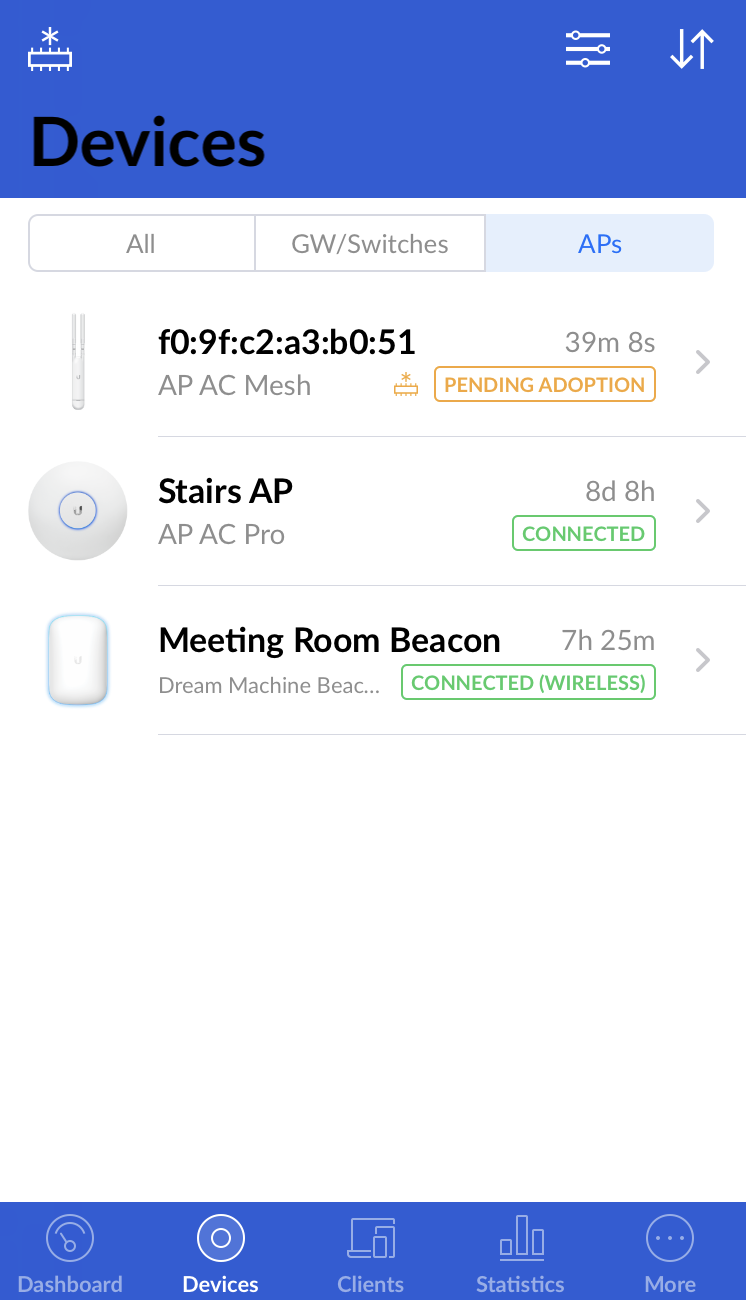
If after a few minutes the device doesn't appear in this list and all the requirements are met, please run across the Troubleshooting commodity in the beneath.
3. Click on the device that is pending adoption and click Adopt under the Actions header at the lesser of the screen. If a newer firmware version is available it will show an upgrade option there besides. Adopt it kickoff, and upgrade after adoption.
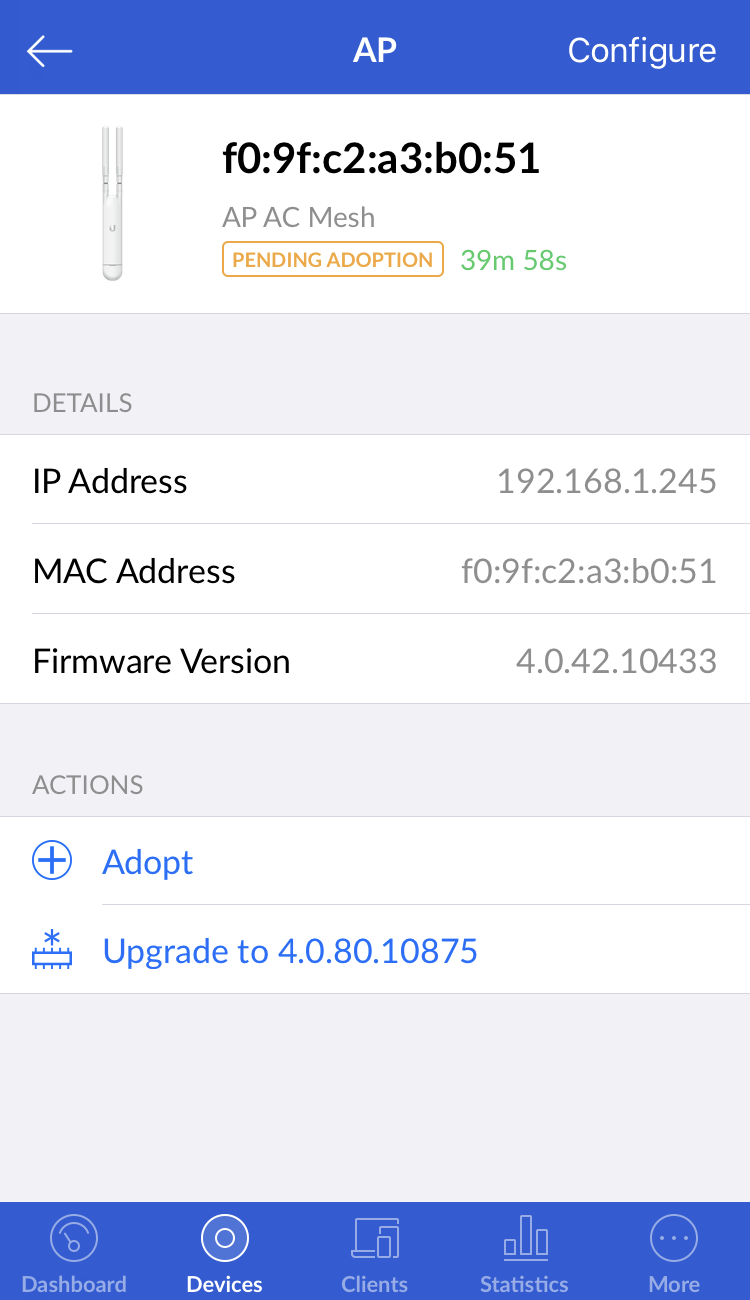
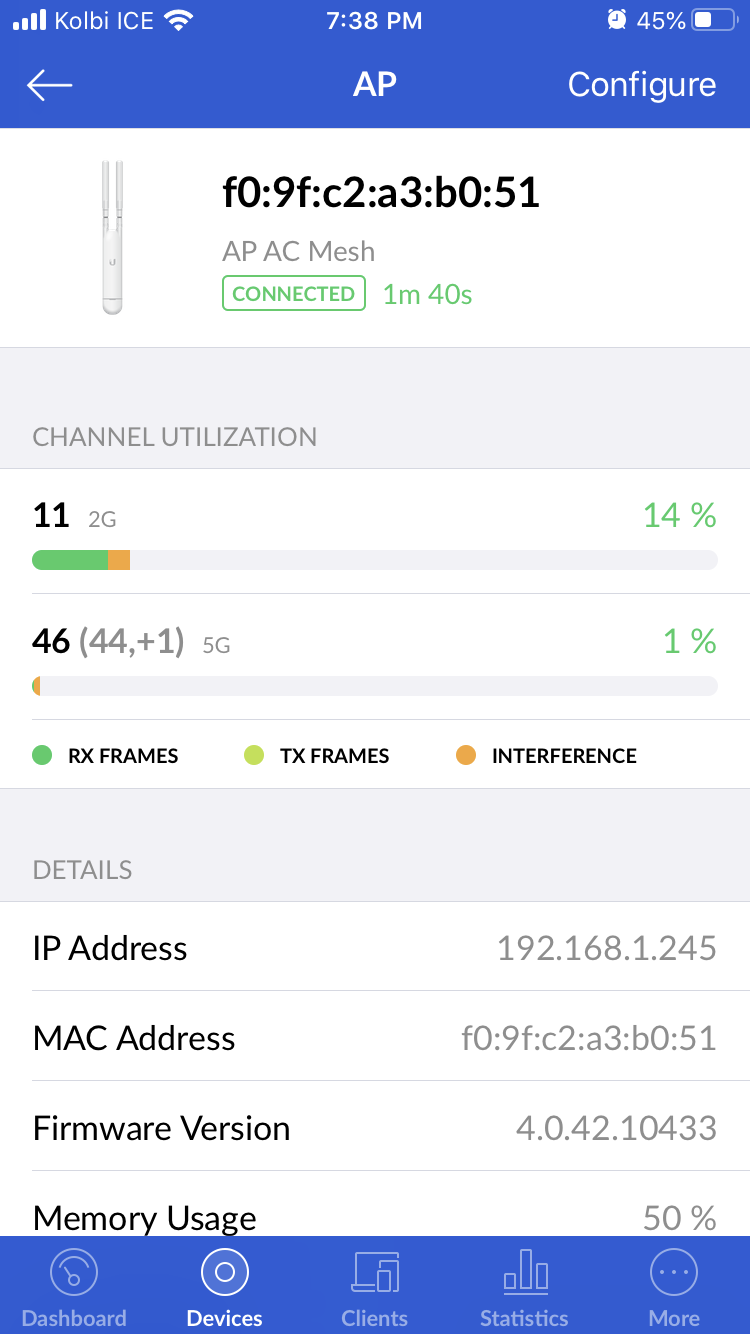
4. The app will show the device go through Adopting and then Provisioning statuses. Later the device is fully adopted, it volition brandish the dark-green Continued status. Exercise not disconnect the device from power while the adoption is on going. You may take to refresh the app's screen if the device's LED has stopped blinking and is a solid bluish but the app nevertheless shows provisioning.
Stride 5: Install the UniFi Controller
ATTENTION: The UniFi Network Controller does not back up Java 9 still. Amazon EC2 at present installs with Java 9, so to ensure compatibility you must uninstall Java nine and install Java 8 for the system to run properly.
Once you lot connect to the Server and are greeted with the Ubuntu Command Line Interface (CLI), do the following:
5.i. Add together the Ubiquiti repository to /etc/apt/sources.list:
echo "deb http://www.ubnt.com/downloads/unifi/debian stable ubiquiti" | sudo tee -a /etc/apt/sources.list
5.2. Add the Ubiquiti GPG Fundamental:
sudo apt-key adv --keyserver keyserver.ubuntu.com --recv 06E85760C0A52C50
5.3. Update the server's repository data:
sudo apt-get update

five.four. Install UniFi:
sudo apt-go install unifi


5.5. Disconnect from the server:
exit

5.6. You may at present close the Terminal or PuTTY window.
five.7. Open up your browser and navigate to https://<elastic-ip>:8443/
NOTE:If the UniFi Network Controller is running on the calculator where you are setting up the AWS Controller, make sure y'all close it earlier trying to navigate to the URL above.

five.8. Complete the UniFi Setup Wizard. Yous will need to skip Footstep 4: Devices Setup as no devices will be available for adoption since the controller is not on the aforementioned subnet. But y'all can even so complete steps 5 and half-dozen.

5.nine. Your controller setup is at present consummate! You may now go on to adopt your UniFi devices using Layer 3 Adoption.
NOTE:Call back that the IP of the controller is the aforementioned as the Elastic IP nosotros prepare above. This is helpful if you are doing an L3 adoption via SSH.
Pace 4: Connect Via SSH to the Instance
Using Windows (PuTTY)
If you are using a Windows computer, y'all can utilize PuTTY to connect to the server via SSH. You will need to convert the Key Pair (UniFiController.pem) file you created earlier from a .pem file to a .ppk file that is supported by PuTTY.
For detailed instructions on how to convert your .pem to a .ppk file and connect to the server using PuTTY on Windows, please read Amazon's PuTTY Setup Guide.
Using macOS or Linux
If you are using a Linux or macOS figurer, you can use the congenital-in SSH client.
Open Terminal and follow these steps:
4.ane. Edit permissions for the .pem file as required for SSH:
chmod 400 /location/to/UniFiController.pem
4.2. Connect to server using SSH and the .pem file, where <rubberband-ip> is the Rubberband IP Address configured previously:
ssh -i "/location/to/UniFiController.pem" ubuntu@<elastic-ip>

Impact of fundamental version state on cryptographic operations
The bear on of primal version state on cryptographic operations depends on whether
the key is used for:
- Symmetric encryption
- Asymmetric encryption or digital signing
Symmetric encryption
Each symmetric encryption fundamental has a designated
primary version which is used at that point in fourth dimension to encrypt data. In
order for a key to exist bachelor for use to encrypt data, it needs to take a
chief primal version which is enabled.
When a central is used to encrypt plaintext, its primary central version is
used to encrypt that data. The data every bit to which version was used to
encrypt data is stored in the ciphertext of the information. Just one version of a
key can be primary at any given point in fourth dimension.
If the principal key version is disabled, that fundamental version cannot be used to
encrypt data. Note that an enabled principal key version tin exist disabled,
scheduled for destruction or destroyed, and a version which is not enabled tin
be made the primary version.
Which cardinal version is primary does not impact the power to decrypt information.
A key version can exist used to decrypt data as long as it is enabled.
Disproportionate encryption or digital signing
Each time an disproportionate cardinal is used for encryption or digital signing, a central
version must exist specified. In order for the cardinal version to be bachelor for
asymmetric encryption or digital signing, the key version must exist enabled. Y'all
can retrieve a key version'southward public key merely if the key version is enabled.
How to Update the Deject Cardinal'due south Firmware with the Deject Key Management UI
1. Access the Cloud Primal Management WebUI, by typing your Cloud Key'southward IP in your browser.
User Tip:Gen2 Cloud Keys will show their IP in the forepart console screen. For gen1 Cloud Keys, discover it in the Host column of the UniFi Cloud Access Portal: https://unifi.ui.com.
2. Yous will country on a warning page, click on Advanced and Go along to <your IP>(unsafe).

iii. Click on Manage Cloud Primal (on gen2 Cloud Keys) or Configure (on gen1 Cloud Keys) to configure your UniFi Cloud Key's settings via the Deject Fundamental's Management UI. The image below is for a UCK-G2-PLUS, each Cloud Fundamental will take a different set of options.

four. Type in the Cloud Fundamental's credentials. These credentials are not the aforementioned equally the UniFi Network Controller credentials. When you initially set up the Cloud Key up, it volition have prompted you to change the password. The default credentials were:
| Username: root Countersign: ubnt | Or | Username: ubnt Password: ubnt |
So chances are, the username is still root (or ubnt). These are the same credentials y'all would use to SSH into your Cloud Key. More data on that .Notation: Afterward you enter the management screen for the first time information technology will inquire you to change the countersign from default values, please brand annotation of this new password as you cannot recover or reset this password.
v. Once inside the Cloud Fundamental UI, go to Settings (or if on UC-CK, the Maintenance tab) and expand the Firmware section to verify if there are updates available. If in that location are, click the Update Now button. If you wish to apply a non-stable version, click on Update Manually. You lot will need the firmware link (or the firmware file), which you tin become from our Downloads page or for the non-stable releases, detect them in the Beta weblog. To access these you lot volition need to accept enabled Early on Access on your account.

Click hither to see Deject Key Gen1 (UC-CK) Instructions.
Go to the Maintenance tab. Here you tin can one time again upgrade the UniFi Network Controller under the UNIFI header. Or change the Cloud Key firmware under the FIRMWARE header. You can Check for Updates to become the latest publicly released version, or if you wish to use a non-stable version, click on Update Manually. You volition need the firmware link, which you can get from our Downloads page or for the non-stable releases, find them in the Beta web log. To admission these you volition demand to take enabled Early Access on your business relationship.

Managing Cloud Subscriptions
View and Download UniFi Cloud Invoices
You can access and Cloud-related invoices/billing data by going tohttps://network.unifi.ui.com > Clicking Settings (Gear icon in lower-left corner) > Cloud > Invoices.

Here you lot can see the amount of invoices and download a copy of them for your own records.
Change Billing Information
If you wish to change your billing information, including Credit Card, Address, etc. Get to https://network.unifi.ui.com > Settings > Cloud > Data > Click Change, update the fields and click Salvage.
Alter Device Tiers
Once you have subscribed to a UniFi Cloud controllers, which is based on the number of devices in tiers of x devices, you tin can change the tier of your controller.
To do this go to https://network.unifi.ui.com > Settings > Cloud > Subscriptions > Select the controller yous wish to update and click «Change Tier», so conform to the desired device tier.
Abolish Subscription/Trial for Single Controller
Y'all can see the status of subscription for each controller at https://network.unifi.ui.com. For a controller that is ready to renew at the subscription renewal date or at the stop of trial it should show the post-obit status.
To cancel your UniFi Cloud subscription or Trial for a unmarried controller, select «Do not renew» next to the controller at https://network.unifi.ui.com.
This volition forbid the controller from beingness renewed at the renewal date or at the expiry of your trial. Prior to cancellation the controller testify every bit follows:
Once this has been done the status should alter from RENEWING to Non-RENEWING. No further activity is needed from the client or Ubiquiti.
Cancel Subscription/Trial for Entire Account
To abolish your UniFi Cloud subscription for all controllers, Go to https://network.unifi.ui.com > Settings > Cloud > Subscriptions > Select Subscription by clicking View, click Cancel Subscription and click Confirm. No farther action is needed from the customer or Ubiquiti.

Applying API central restrictions
API keys are unrestricted by default. Unrestricted keys are insecure considering
they can be used by anyone from anywhere. For product applications, y'all
should set both application restrictions and API restrictions.
To add API key restrictions:
-
Navigate to the
APIs & Services→Credentials
panel in Cloud Panel. -
Select the proper noun of an existing API central.
Adding application restrictions
Application restrictions specify which web sites, IP addresses, or apps can use
an API cardinal. Add application restrictions based on your application blazon. You
can just ready ane restriction type per API central.
Choose the brake type based on the needs of your application.
-
Use None for testing purposes just.
-
Use HTTP referrers for API clients that run on a spider web browser, and so that only
the specified pages can telephone call the API. These types of applications expose their
API keys publicly, then we recommend using a
service business relationship instead. Come across the
section below for
examples. -
Apply IP addresses to limit API fundamental access to certain IP addresses.
-
Use Android apps for Android applications. This option requires adding
your package name and SHA-1 signing-certificate fingerprint. -
Use iOS apps for iOS applications. This option requires calculation at least
ane iOS bundle identifier to restrict API calls to specific iOS bundles.
Adding HTTP restrictions
API keys used by spider web applications should have HTTP restrictions. To add
HTTP restrictions:
-
Select HTTP referrers (web sites) in the Application restrictions
section. -
Input at least one restriction in the Website restrictions department.
-
If your domain supports both HTTP and HTTPS, both restrictions must be added
separately. -
You tin can optionally use wildcard characters () for the subdomain and/or
path.
The following table shows instance scenarios and restrictions, from near
restrictive to least restrictive. We recommend using the most restrictive
example that fits your utilise case.
| Scenario | Restrictions |
|---|---|
| Allow a specific URL. | Add together a unmarried restriction with an verbal path. For example: |
| Let any URL in a single subdomain or naked domain. | You must set up at least 2 restrictions to allow an entire domain.
|
| Allow whatsoever subdomain URLs in a single domain. | Yous must fix at to the lowest degree two restrictions.
|
Adding API restrictions
API restrictions specify which APIs can exist called using the API key. All API
keys used by production applications should have API restrictions.
To gear up API restrictions:
-
Select Restrict cardinal in the API restrictions section.
-
Select all API names that your API key needs to call from the dropdown.
-
Select the Salve button.
Ubiquiti SSO Cloud Credentials
The Ubiquiti Cloud username and countersign are your Single Sign-On, UI.com account credentials created in https://account.ui.com/. This set of credentials is used in the UI Customs, the UI Shop, and the UI Help Centre. To change this username and password go to https://account.ui.com. This is also where you would enable (or disable) your 2FA verification. See this article for more: How to Enable / Disable Two Factor Authentication (2FA).
How to create an account:
Click to Aggrandize
- Visit: https://account.ui.com
- Under the Sign In push, click on Not a Member? Create business relationship.
- Fill in the required information.
- Get-go proper noun — First proper noun of the user account owner.
- Last name — Final name of the user account owner.
- Username — Public display proper name for the account. Used for sign in on required Ubiquiti websites.
- Email — Email address to receive notification emails. Can likewise be used for sign in. Will be used by Ubiquiti Support to contact you if necessary.
- Password — This countersign can be any combination of characters as long as it meets the minimum of 8 characters in length.
- Agree to the terms and policies, decide if you wish to receive periodic newsletters and updates and click Register.
User Tip:If you wish to use your SSO Cloud credentials for your Controller and take ane less set up of credentials to worry well-nigh, yous can prepare this up past logging into your Controller and going to Settings > Remote Access and enabling the Enable Local Login with Ubiquiti Business relationship. Delight make sure to read the tooltip in the Controller before enabling.
Troubleshooting Duplicate Controllers
Asunder Devices After Migration
If after migrating the controller to its new host, the devices appear as asunder in the Devices section, it could mean there is a duplicate controller consequence, or that the devices are still adopted by the old controller.

To verify, log into the UniFi Cloud Access portal using your Ubiquiti SSO account: https://network.unifi.ui.com/ and see how many controllers appear listed. If yous come across something similar to the image above, where both controllers are still listed, it probably means both controllers are running on the aforementioned LAN, at the same time. This volition create an adoption failure and other connectivity issues.
To address this, physically disconnect the host of the one-time controller to make sure at that place is no confusion. Refresh the new controller and after a moment, the one-time controller should disappear from the UniFi Cloud Access Portal list, and the devices in the new controller should begin to appear every bit adopted. Delight encounter the articles beneath for more than troubleshooting assist.
UniFi Mobile App Alert: Controllers with Same UUIDs
For cases where the mistake «Controllers with Same UUID» is seen, please follow these instructions to solve:
1. Remove and disable Cloud Admission nether Settings > Remote Access > Disable and Remove Cloud Admission.
2. Forget both controllers from the Deject Access Portal listing, past clicking on Forget on each controller row.
3. Enable and reconfigure Cloud Admission in one case again in Settings > Remote Admission.
4. Rename the new controller to make sure it is not dislocated with the old one in Settings > Controller > Controller Name.
Requirements
- See the device'southward Quick Offset Guide to verify the hardware setup is washed correctly. Find the QSG in the device's box or in the Downloads page, under the Documentation section. Use the carte du jour to the left to filter down to your specific device. Using the QSG, you can as well adopt the device when setting up the Controller for the offset fourth dimension past post-obit the QSG and then the Setup Magician.
- UniFi devices can be adopted when continued directly to the same network as the controller (local adoption), or remotely if remote admission is enabled on the controller. The process described in this commodity is for local adoption.
- The device needs to be powered upwardly, and unadopted as indicated by a steady white LED. If the device were previously connected to another UniFi Network Controller, reset the device so they're in factory default state earlier attempting to adopt. If they announced as «Managed by Other» you lot can follow the instructions in the article plant in the Related Articles beneath if you don't wish to reset them, although that's the easiest manner to adopt them.
- The controller and devices must exist able to transport and receive traffic over determined ports. See this commodity for information: UniFi — Ports Used. You volition non need to alter anything most this unless y'all face problems or have already changed default ports before.
- Merely if adopting UniFi Security Gateway (USG) — Verify that the default LAN network in Settings > Networks, does not conflict with the network to which your USG's WAN interface will be connected. If your USG will be given a DHCP address on the default 192.168.1.10 subnet, make certain to change the subnet of LAN network in controller settings to a different subnet, for instance: change to 192.168.2.1/24, then "Update DHCP Telescopic" prior to adopting the USG. Every bit an alternative, we recommend in these cases that if possible the upstream router exist put in Bridge Manner as to limit potential complications.
Symptoms
All of the post-obit symptoms can indicate stability issues with your Deject Primal:
- Flashing white LED indicating the UniFi Deject Key is disconnected.
- Deject Key may testify as offline in UniFi Cloud Access Portal (https://network.unifi.ui.com/)
- The Cloud Key management UI may not exist accessible via straight URL when typing the Cloud Key's IP on browser: https://:8443/manage/
- UniFi service shows as non running through Web UI (https://, Select choice Configure > Maintenance > Service > End UniFi will exist grayed out indicating information technology is already offline)
- UniFi service will not start past clicking the push «Start UniFi».
Source: https://server-unit.ru/unifi-cloud-key.html
Belum ada Komentar untuk "Unifi Switch 48 Device Busy Try Again"
Posting Komentar