In What Film Does Bacall Say to Bogart Maybe Shave
The Designing Woman
The perfect career of Lauren Bacall—an exquisite dazzler with the quickest mind in the room—in five films.
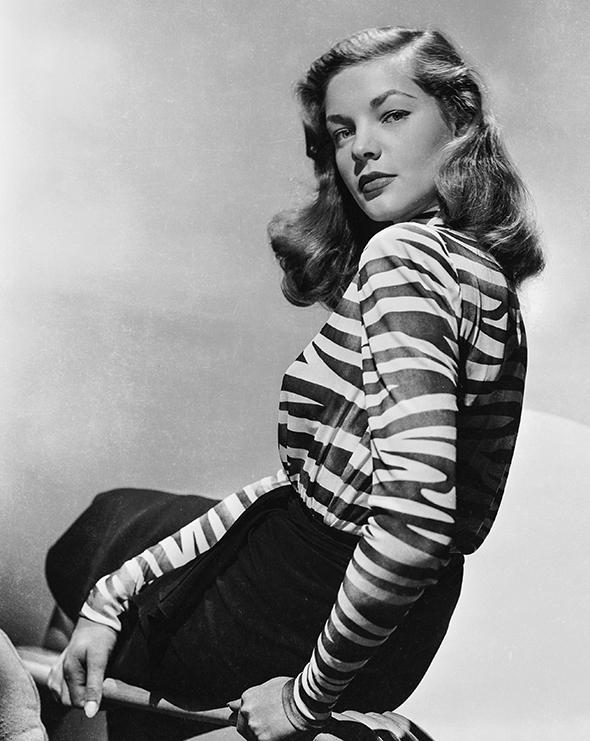
Photo via John Kobal Foundation/Getty Images
She was the pure molten essence of a mid-20th-century flick star—if something that's molten can somehow too be absurd. Her beauty was classical, sculptural, a picayune remote, and all her life she carried herself not only with a dancer'southward grace, but with a sly sensation of the power conferred on her by that sheer physical exquisiteness. But even at age nineteen—playing opposite a 44-year-old Humphrey Bogart in Howard Hawks' To Take and Take Non, in what'due south surely 1 of the most enduring screen debuts in Hollywood history—Lauren Bacall also conspicuously conveyed the sense of having the quickest mind in the room. When the people in the room include Bogart and Hawks, that's maxim something.
Hither she is walking into Bogart's life and ours for the first fourth dimension—a micro-scene, less than a minute long and with simply ii lines of dialogue (both hers), but look at what a tight game of erotic gamesmanship and mutual risk assessment these two are playing. "Anybody got a match?" she asks, and equally he gets out the pack to toss to her, we get the pun: They have a lucifer, a sizzling hot one that's virtually to set burn down to Bogart's third matrimony. Bacall's timing as she lights her cigarette and tosses the burnt-out match over her shoulder is pure comic bliss.
According to fable, Bacall was so nervous during filming that she invented the chin-down, eye-locking gaze that her publicist would afterward dub "the Await" in club to go along from visibly trembling on-camera. Yet she spoke that drop-dead noir dialogue, to quote film historian David Thomson, "as if she had been up all night writing the script." (In fact, it was William Faulkner who had been burning the midnight oil; he contributed to a belatedly rewrite of the screenplay, an adaptation of a novel past his archrival Ernest Hemingway.)
2 years later in The Large Sleep—another Hawks product co-scripted by Faulkner, this time from a Raymond Chandler novel—Bogart and Bacall, by then married, had developed a slightly different, if just as smoldering, onscreen dynamic. Equally the detective Philip Marlowe and his possibly duplicitous client Vivian Rutledge, the two circumvolve one some other like hawks, interrogating the pregnant of every give-and-take and gesture. In this scene, Vivian, delivering a doctored version of the truth to her just-hired individual heart, inadvertently gives away her own "tell": When nervous, she toys with the hem of her skirt, allowing Marlowe to deduce that she's lying even as she reveals a strategic glimpse of gam. The moment the mounting tension between the two resolves in a slightly naughty sight gag is another triumph of Bacall's undersung comic timing.
In betwixt To Have and Have Non and The Big Sleep, Bacall received terrible notices for her performance in the Graham Greene adaptation Confidential Agent, which hurt her confidence and her career for years. When she wasn't acting contrary Bogart, she could sometimes appear stiff and solemn, her natural reserve coming off equally chilly remoteness (though when she started to perform onstage afterwards in life, she establish a new exuberance that would somewhen win her two Tonys). Only in the correct moving-picture show office, that chill could be strong. In Douglas Sirk'southward peachy 1956 melodrama Written on the Wind, Bacall plays the wife of an alcoholic playboy (Robert Stack)—a homo who, by all highly coded appearances, is a miserable closet case secretly in beloved with his all-time friend (Stone Hudson). In the scene below, the iii of them run into at a bar for a subtext-laden and thoroughly joyless drink. Sirk leaves the camera on Bacall's face equally she watches Stack fall autonomously; her about affectless stoicism is the perfectly judged counterpart to his ostentatious despair. This is the face of a adult female who knows what's going on all the same can't quite allow herself know.
Bacall lost Bogart to cancer in 1957 after 11 happy years, two children, and a mere four movies together. In the decades after—especially after she was remarried to Jason Robards, with whom she would take some other son, the role player Sam Robards—she would grow tired of her name being inextricably associated with her kickoff hubby's, to what she sometimes saw as the exclusion of her ain identity and achievements (though she always acknowledged Bogart as the formative love of her life). The same year he died, she appeared opposite Gregory Peck in Vincente Minnelli's Designing Woman, the story of a fiercely independent clothing designer who enters into a fractious marriage with a loving only oafish sportswriter. In retrospect, choosing the role of a headstrong adult female opposite a well-established leading man similar Peck seems similar Bacall'due south way of letting Hollywood know that, heartbroken as she might exist, she was adamant to carry on acting, loving, and living—which she proceeded to do in chiliad style for the next six decades. If yous ever doubted Bacall could display onscreen chemistry with another human besides Bogie, stay tuned through the end of the clip below, in which she breaks off midclinch to playfully crumb on Peck's ear.
Still, I confess that upon hearing about Lauren Bacall'due south passing at the age of 89 after a long, total life on stage, on screen, and in the world, it was a scene between her and Bogart that I thought of first—a moment midway through their third film together, Delmer Daves' Nighttime Passage (1947), in which she plays a bohemian painter type who winds up sheltering an escaped convict in her San Francisco apartment. Bogart's graphic symbol has undergone elaborate plastic surgery to modify his appearance. For the get-go third of the film, the audience has seen his confront only rarely and in deep shadow, so that when Bacall finally removes his bandages, the human who's waiting below is meant to be a reveal for the audience equally well as for her character. Simply of course, we all know who's nether there.
With great gentleness and gravity, Bacall sits Bogart downwards on the edge of the bed and cuts abroad the gauze wrappings that obscure all simply his ineffably sad, searching eyes. The face up that emerges is the ane we've been waiting for all movie long—that familiar craggy mug that belongs, with a cosmic rightness, with the elegant, sculpted features of the woman looking into it. Just Betty (as her friends continued to call her all her life) doesn't fall into a swoon that easily. This is a woman who, fifty-fifty as she's falling head over heels in honey, wants to make sure the rest of power periodically swings in her direction. After a absurd cess of her houseguest'due south new look, she suggests a shave and a change of clothes. Afterward that, she tells him dryly, maybe she can "get a fresh impression," as if they were meeting for the very first time. Anybody got a match?
Read more than on Lauren Bacall.
Source: https://slate.com/culture/2014/08/lauren-bacall-obituary-five-films-that-encapsulate-her-career-video.html
Belum ada Komentar untuk "In What Film Does Bacall Say to Bogart Maybe Shave"
Posting Komentar