Concert Art Music Composer From the Renaissance to the Present
History of Classical Music
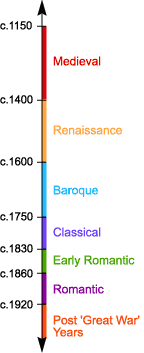
Medieval (c.1150 - c.1400)
This is the first period where we tin can begin to be fairly certain as to how a great deal of the music which has survived actually sounded. The earliest written secular music dates from the 12th century troubadours (in the form of virelais, estampies, ballades, etc.), only about notated manuscripts emanate from places of learning usually connected with the church, and therefore inevitably have a religious basis.
Gregorian dirge and plainsong which are monodic (i.e. written as one musical line) gradually adult during the 11th to 13th centuries into organum (i.e. two or three lines moving simultaneously simply independently, therefore almost inadvertently representing the ancestry of harmony). Organum was, however, initially rather stifled by rigid rules governing melody and rhythm, which led ultimately to the then-called Ars Nova period of the 14th century, principally represented by the composers de Vitry, Machaut, and Landini.
Recommended Recording:
- Adorate Deum: Gregorian Chant from the Proper of the Mass Nova Schola Gregoriana
Naxos 8.550711
Renaissance (c.1400 - c.1600)
The fifteenth century witnessed vastly increased freedoms, most peculiarly in terms of what is really perceived as 'harmony' and 'polyphony' (the simultaneous motility of two or three interrelated parts). Composers (although they were barely perceived as such) were even so almost entirely devoted to choral writing, and the few instrumental compositions which have survived ofttimes create the impression (in many cases entirely accurately) of being vocal works in disguise, only minus the words.
There is obvious new delight in textural variety and contrast, so that, for case, a particular department of text might exist enhanced by a vocal part dropping out momentarily, only to return again at a special moment of emphasis. The iv most influential composers of the fifteenth century were Dunstable, Ockeghem, Despres and Dufay.
The second half of the 16th century witnessed the beginnings of the tradition which many music lovers readily associate with the normal experience of 'classical' music. Gradually, composers moved away from the modal organization of harmony which had predominated for over 300 years (and yet sounds somewhat archaic to some mod ears), towards the organisation of their work into major and minor scales, thereby imparting the potent sensation of each piece having a definite tonal eye or 'key'.
This was besides something of a aureate flow for choral composition as a seemingly endless flow of a capella (unaccompanied) masses, motets, anthems, psalms and madrigals flowed from the pens of the masters of the age. In add-on, instrumental music came into its own for the outset time, particularly keyboard music in the form of fantasias, variations, and dance movements (galliards, pavanes etc.). Composers of detail note include Dowland, Tallis, Byrd, Gibbons, Frescobaldi, Palestrina, Victoria, Lassus, Alonso Lobo, Duarte Lobo, Cardoso and Gesualdo.
Recommended Recordings:
- Byrd: Mass for Iv Voices; Mass for Five Voices; Infelix ego
Naxos 8.550574 - Gesualdo: Sacred Music for V Voices (Consummate)
Naxos viii.550742 - Lamentations
Music by Tallis, White, Palestrina, Lassus and de Brito
Naxos 8.550572 - Lassus: Missa super entre vous; Infelix ego; Missa imitationem moduli susanne un tour
Naxos 8.550842 - Lobo: Missa pro defunctis / Cardoso: Missa pro defunctis
Naxos 8.550682 - Palestrina: Missa Papae Marcelli; Missa aeterna Christi munera
Naxos viii.550573 - Palestrina: Missa hodie Christus natus est; Hodie Christus natus est; Stabat mater / Lassus: Missa bell' amfitrit' altera
Naxos eight.550836 - Tallis: Mass for Iv Voices; Motets
Naxos 8.550576 - Victoria: Missa O magnum mysterium; Missa O quam gloriosum / A. Lobo: Versa est in luctum
Naxos viii.550575
Baroque (c.1600 - c.1750)
During the Baroque menstruum, the foundations were laid for the following 300 or then years of musical expression: the thought of the modern orchestra was born, along with opera (including the overture, prelude, aria, recitative and chorus), the concerto, sonata, and modern cantata. The rather soft-grained viol string family of the Renaissance was gradually replaced by the bolder violin, viola and cello, the harpsichord was invented, and important advances were made in all instrumental groups.
Until most 1700, the former modes still exerted themselves from time to fourth dimension by colouring certain melodic lines or chord progressions, simply from the outset of the 18th century the modern harmonic system based upon the major and modest scales was finer pan-European. Choral music no longer dominated, and as composers turned more and more to writing idiomatic instrumental works for ensembles of increasing color and multifariousness, and then 'classical' music (as opposed to 'popular') gradually began to work its way into the very fabric of social club, being played outdoors at dinner parties or special functions (e.g. Handel'southward Water Music), or as a spectacle in the form of opera. On a purely domestic level, every wealthy lady would have a spinet to play, and at meal-times the large and rich houses would use musicians to play what was popularly called Tafelmusik in Germany, of which Telemann was perhaps the near famous composer.
Of the many 17th century composers who paved the way for this pop explosion of 'classical' music, the following were outstanding: Monteverdi, Corelli, Alessandro Scarlatti, Schutz, Buxtehude, Purcell and Lully. Yet, the about popular composers of the catamenia, indeed those who seem to define past their very names the sound of Baroque music at its most colourful and sophisticated are Johann Sebastian Bach, Handel, Telemann, Rameau, François Couperin, Domenico Scarlatti, and Vivaldi, all of them at their creative elevation during the offset half of the 18th century.
Classical (c.1750 - c.1830)
The Baroque era witnessed the creation of a number of musical genres which would maintain a hold on limerick for years to come, withal it was the Classical period which saw the introduction of a class which has dominated instrumental composition to the present day: sonata form. With it came the evolution of the modern concerto, symphony, sonata, trio and quartet to a new summit of structural and expressive refinement. If Baroque music is notable for its textural intricacy, then the Classical catamenia is characterised by a virtually-obsession with structural clarity.
The seeds of the Classical age were sown by a number of composers whose names are now largely forgotten such every bit Schobert and Honnauer (both Germans largely agile in Paris), as well as more than historically respected names, including Gluck, Boccherini and at least three of Johann Sebastian Bach'south sons: Carl Phillip Emmanuel, Wilhelm Friedmann and Johann Christian (the so-called 'London' Bach). They were representative of a period which is variously described as rococo or galante, the former implying a gradual movement away from the bamboozlement of the High Baroque, the latter an entirely novel style based on symmetry and sensibility, which came to dominate the music of the latter half of the 18th century through ii composers of extraordinary significance: Joseph Haydn and Wolfgang Amadeus Mozart.
Early on Romantic (c.1830 - c.1860)
As the Classical catamenia reached its zenith, it was condign increasing clear (particularly with the late works of Beethoven and Schubert) that the amount and intensity of expression composers were seeking to accomplish was beginning to go beyond that which a Classically sized/designed orchestra/piano could possibly encompass. The next period in musical history therefore plant composers attempting to balance the expressive and the formal in music with a diversity of approaches which would have left composers of any previous age utterly bewildered. Every bit the musical map opened up, with nationalist schools showtime to emerge, it was the search for originality and individuality of expression which began here that was to become such an over-riding obsession in the present century.
The Romantic era was the golden age of the virtuoso, where the most fiendishly difficult music would exist performed with nonchalant ease, and the about innocuous theme in a composition would exist developed at great length for the enjoyment of the doting audition. The emotional range of music during this flow was considerably widened, as was its harmonic vocabulary and the range and number of instruments which might be called upon to play it. Music often had a 'programme' or story-line fastened to it, sometimes of a tragic or despairing nature, occasionally representing such natural phenomena as rivers or galloping horses. The next hundred years would find composers either embracing whole-heartedly the ideals of Romanticism, or in some way reacting against them.
Of the early Romantic composers, two Nationalists deserve special mention, the Russian Glinka (of Russlan and Ludmilla fame) and the Bohemian Smetana (composer of the pop symphonic poem Vltava or 'The Moldau'). However, the six leading composers of the age were undoubtedly Berlioz, Chopin, Mendelssohn, Schumann, Liszt and Verdi.
Late Romantic (c.1860 - c.1920)
With the honourable exceptions of Brahms and Bruckner, composers of this period shared a full general trend towards allowing their natural inspiration gratuitous rein, often pacing their compositions more in terms of their emotional content and dramatic continuity rather than organic structural growth. This was an era highlighted by the extraordinarily rapid appearance of the national schools, and the operatic supremacy of Verdi and Wagner. The eventual end of Romanticism came with the fragmentation of this basic style, composers joining 'schools' of composition, each with a style that was in vogue for a curt period of time.
Recommended Recordings:
- Albéniz: Iberia
Falla: Iii-Cornered Chapeau; El Amor Brujo; La Vida Breve
Naxos viii.550174 - Balakirev: Islamey
Mussorgsky: Pictures at an Exhibition (piano version)
Naxos 8.550044 - Bizet: Carmen
Naxos 8.660005-07 (three CD'southward) - Borodin: Symphonies Nos. i-3
Naxos 8.550238 - Brahms: Hungarian Dances (Complete)
Naxos eight.550110 - Brahms: Symphony No. i ; Tragic Overture ; Academic Festival Overture
Naxos 8.557428 - Brahms: Symphony No. ii ; Hungarian Dances
Naxos 8.557429 - Brahms: Symphony No. 3 ; Haydn Variations
Naxos viii.557430 - Brahms: Symphony No. 4 ; Hungarian Dances Nos. 2, 4-9 (orch. Breiner)
Naxos 8.570233 - Brahms: Symphonies Nos. ane-iv; Tragic Overture; Haydn Variations; Academic Festival Overture; Serenades Nos. i & 2
Naxos 8.504001 (4 CD's) - Brahms: Violin Concerto
Bruch: Violin Concerto No. 1
Naxos 8.550195 - Bruckner: Symphony No. 4 'Romantic'
Naxos 8.550154 - Debussy: Suite Bergamasque; 2 Arabesques; Images; Préludes; La plus que lente
Naxos 8.550253 - Delibes: Ballet Music (Coppélia; Sylvia; La Source); Le Roi s'amuse; Kassya - Trepak
Naxos eight.550080 - Delius: Brigg Fair; In a Summer Garden
Elgar: Enigma Variations; Pomp and Circumstance Marches Nos. ane & 4; Salut d'amour
Naxos 8.550229 - Dvořák: Slavonic Dances (Complete)
Naxos 8.550143 - Symphony No. nine 'New World'; Symphonic Variations
Naxos eight.550271 - Franck: Symphony; Prelude, Choral and Fugue
Naxos viii.550155 - Grieg: Peer Gynt, Suites Nos. 1and 2 / Sigurd Jorsalfar / Bergliot
Naxos 8.553397 - Holst: The Planets; Suite de Ballet
Naxos eight.550193 - Janáček: Sinfonietta; Taras Bulba; Lachian Dances
Naxos 8.550411 - Kodály: Peacock Variations; Dances of Galánta and Marosszék
Naxos 8.550520 - Lalo: Symphonie Espagnole
(with works by Saint-Saëns, Sarasate and Ravel)
Naxos 8.550494 - Leoncavallo: Pagliacci
Naxos 8.660021 - Mahler: Symphony No. i in D
Naxos 8.550120 - Mascagni: Cavalleria Rusticana
Naxos 8.660022 - Puccini: Tosca
Naxos viii.660001-02 (ii CD's) - Rachmaninov: Piano Concerto No. 2; Rhapsody on a Theme of Paganini
Naxos viii.550117 - Ravel: Boléro; Daphnis et Chloé; Ma mère l'oye;
Naxos 8.550173 - Respighi: Pines of Rome; Fountains of Rome; Roman Festivals
Naxos eight.550539 - Rimsky-Korsakov: Sheherazade; Tsar Saltan Suite
Naxos eight.550726 - Saint-Saëns: Carnival of the Animals
(coupled with Prokoviev: Peter and the Wolf; Britten: Immature Person's Guide - see below)
Naxos 8.550499 - Satie: Pianoforte Works (Selection)
Naxos 8.550305 - Sibelius: Finlandia; Valse Triste; Swan of Tuonela; Karelia Suite
Naxos 8.550103 - Johann Strauss II: Famous Waltzes, Polkas, Marches and Overtures Vol. 2
Naxos 8.550337 - Richard Strauss: Also sprach Zarathustra; Salome's Trip the light fantastic;
Der Rosenkavalier (Waltzes)
Naxos 8.550182 - Tchaikovsky: Capriccio Italien; 1812 Overture; Romeo and Juliet Overture; Marche Slave
Naxos 8.550500 - Tchaikovsky: The Nutcracker (Highlights)
Naxos eight.550515 - Wagner: Orchestral excerpts from the operas
Naxos 8.550136
Mail 'Great State of war' Years (c.1920 - Nowadays)
The flow since the Smashing War is undoubtedly the most bewildering of all, every bit composers have pulled in diverse plainly contradictory and opposing directions. Typical of the dilemma during the inter-war years, for case, were the Austrians, Webern and Lehar, the former was experimenting with the highly compressed and advanced class known as 'serial structure', while simultaneously Lehar was even so indulging in an operetta mode which would not have seemed out of identify over half a century beforehand.
And so various are the styles adopted throughout the greater function of the present century that only by experimentation can listeners detect for themselves whether certain composers are to their detail taste or not. Nevertheless, the post-obit recordings serve equally an excellent introduction and will certainly repay investigation:
Recommended Recordings:
- Antill: Corroboree ; Outback Overture
Naxos 8.570241 - Britten: The Young Person'due south Guide to the Orchestra; Prokofiev: Peter and the Wolf; Saint-Saens: Funfair of the Animals
Naxos viii.550499 - Copland: Rodeo; Baton the Child; Appalachian Bound; Fanfare for the Common Homo
Naxos eight.550282 - Gershwin: Piano Concerto; Rhapsody in Blue; An American in Paris
Naxos eight.550295 - Orff: Carmina Burana
Naxos 8.550196 - Prokofiev: Romeo and Juliet (Highlights)
Naxos 8.550380 - Shostakovich: Symphonies Nos. five & 9
Naxos 8.550427 - Stravinsky: Jeu des cartes; Rite of Jump (1947 version)
Naxos eight.550472
See 20th Century and Modern Catalogue List
Source: https://www.naxos.com/education/brief_history.asp
Belum ada Komentar untuk "Concert Art Music Composer From the Renaissance to the Present"
Posting Komentar